Lookup · 51 jurisdictions
Minimum wage by state: today’s rate and what changes in 2027
The federal minimum wage is $7.25 an hour, but many states and cities set more. Fourteen states raise their rates on January 1, 2027, and many cities and counties set their own. An employer pays the highest rate that applies.
In short
- The federal minimum wage is $7.25 an hour. It has not changed since July 24, 2009.
- Where a state or local rate is higher, the employer must pay the higher rate.
- Washington has the highest state rate, $17.13, rising to $17.73 on January 1, 2027. The District of Columbia is higher, at $18.40.
- In twenty states the working rate is the federal $7.25. Five of them have no minimum wage law of their own.
- Seven states allow no tip credit: tipped workers get the full rate there.
Which rate applies
Three governments can set a minimum wage for the same job: the federal government, the state and the city or county. The employer must pay the highest one that applies where the work is done.
The federal rate is $7.25. Under the federal Fair Labor Standards Act (FLSA), an employer may also pay a new employee under age 20 at least $4.25 for the first 90 consecutive calendar days.
Georgia and Wyoming have state rates of $5.15, below the federal rate. Employers the FLSA covers owe $7.25 there.
What changes on January 1, 2027
These fourteen states have set their 2027 rates. Each new rate is in a statute or the state’s own notice.
| State | In 2026 | From January 1, 2027 |
|---|---|---|
| Arizona | $15.15 | $15.65 |
| California | $16.90 | $17.40 |
| Connecticut | $16.94 | $17.48 |
| Maine | $15.10 | $15.70 |
| Michigan | $13.73 | $15.00 |
| Minnesota | $11.41 | $11.87 |
| Montana | $10.85 | $11.20 |
| Nebraska | $15.00 | $15.26 |
| New Jersey | $15.92 | $16.48 |
| Ohio | $11.00 | $11.40 |
| Rhode Island | $16.00 | $17.00 |
| South Dakota | $11.85 | $12.30 |
| Virginia | $12.77 | $13.75 |
| Washington | $17.13 | $17.73 |
Two more states are likely to move on the same date, but neither rate is final. Colorado’s $15.71 is in a proposed rule; the hearing was November 2, 2026, and the state’s rules page still lists it as proposed. Vermont’s rate rises each January 1, and the state has not posted the 2027 figure.
New York stays at $17.00 and $16.00 on January 1, 2027. The next changes in Alaska, the District of Columbia and Oregon come on July 1, 2027, not January 1. Florida’s next change is January 1, 2028, and Hawaii’s is too.
Minimum wage by state
Each state’s rate today, its next scheduled change and the lowest cash wage for a tipped worker. “Federal” means the state has no rate of its own that covers most employers.
| State | Minimum wage now | Next change | Tipped cash wage | Good to know |
|---|---|---|---|---|
| Alabama | $7.25 (federal) | No change scheduled | $2.13 (federal) | No state minimum wage law. The federal rate applies to employers the FLSA covers. |
| Alaska | $14.00 | $15.00 on July 1, 2027 | No tip credit | Indexed to inflation after that step. |
| Arizona | $15.15 | $15.65 on January 1, 2027 | $12.15 | Does not cover businesses under $500,000 in gross revenue that are exempt from the FLSA minimum wage. Tip credit of up to $3.00. Flagstaff and Tucson set higher rates. |
| Arkansas | $11.00 | No change scheduled | $2.63 | State law covers employers with four or more employees. |
| California | $16.90 | $17.40 on January 1, 2027 | No tip credit | Fast food workers at covered chains get at least $20.00. Covered health care workers have higher rates. Many cities set their own. |
| Colorado | $15.16 | $15.71 proposed for January 1, 2027; not yet adopted | $12.14 | Denver, Edgewater, Boulder and Boulder County set their own rates. |
| Connecticut | $16.94 | $17.48 on January 1, 2027 | $6.38 | Hotel and restaurant workers. Bartenders get $8.23. |
| Delaware | $15.00 | No change scheduled | $2.23 | For workers who get more than $30 a month in tips. |
| District of Columbia | $18.40 | July 1, 2027; not yet announced | $10.30 | Changes each July 1. All employers, regardless of size. |
| Florida | $15.00 | January 1, 2028; not yet announced | $11.98 | Reached $15.00 on September 30, 2026. Local rates for private employers are not allowed. |
| Georgia | $7.25 (federal); state rate $5.15 | No change scheduled | $2.13 (federal) | Most employers owe the federal rate. The state rate applies only in rare cases outside the FLSA. |
| Hawaii | $16.00 | $18.00 on January 1, 2028 | $14.75 | The tip credit applies only if wages plus tips are at least $7.00 above the minimum. |
| Idaho | $7.25 | No change scheduled | $3.35 | Tracks the federal rate. Local rates are not allowed. |
| Illinois | $15.00 | No change scheduled | $9.00 | State law covers employers with four or more employees, not counting immediate family. Workers under 18 with 650 hours or fewer: $13.00. Chicago and Cook County set their own rates. |
| Indiana | $7.25 | No change scheduled | $2.13 | Equals the federal rate. Local rates above it are not allowed. |
| Iowa | $7.25 | No change scheduled | $4.35 | New workers may get $6.35 for their first 90 calendar days. |
| Kansas | $7.25 | No change scheduled | $2.13 | State law covers only employers the FLSA does not. Others follow the federal rate. |
| Kentucky | $7.25 | No change scheduled | $2.13 | Rises only if the federal rate rises. |
| Louisiana | $7.25 (federal) | No change scheduled | $2.13 (federal) | No state minimum wage law. The federal rate applies to employers the FLSA covers. |
| Maine | $15.10 | $15.70 on January 1, 2027 | $7.55; $7.85 in 2027 | Portland and Rockland have their own ordinances. |
| Maryland | $15.00 | No change scheduled | $3.63 | Workers under 18 may get 85% of the state rate. Montgomery, Howard and Prince George’s counties set higher rates. |
| Massachusetts | $15.00 | No change scheduled | $6.75 | Most agricultural workers have a separate $8.00 minimum. |
| Michigan | $13.73 | $15.00 on January 1, 2027 | $5.49 | The tipped rate is a share of the minimum: 40% in 2026, 42% in 2027. Covers employers with 2 or more employees. |
| Minnesota | $11.41 | $11.87 on January 1, 2027 | No tip credit | Minneapolis and St. Paul set higher rates. |
| Mississippi | $7.25 (federal) | No change scheduled | $2.13 (federal) | No state minimum wage law. The federal rate applies to employers the FLSA covers. |
| Missouri | $15.00 | No change scheduled | $7.50 | Retail and service businesses with under $500,000 in annual gross income are not covered. A 2025 law ended the inflation adjustment. Local rates are not allowed. |
| Montana | $10.85 | $11.20 on January 1, 2027 | No tip credit | Businesses the FLSA does not cover, with gross sales of $110,000 or less, may pay $4.00. |
| Nebraska | $15.00 | $15.26 on January 1, 2027 | $2.13 | State law covers employers with four or more employees. A fixed 1.75% raise each January 1. Local ordinances in Lincoln and Omaha are in dispute in court. |
| Nevada | $12.00 | No change scheduled | No tip credit | One rate for all employees since July 1, 2024. |
| New Hampshire | $7.25 | No change scheduled | $3.27 | Equals the federal rate. |
| New Jersey | $15.92 | $16.48 on January 1, 2027 | $6.05; $6.61 in 2027 | Small (fewer than six employees) and seasonal employers: $15.23, then $16.25. Farm workers: $14.20, then $15.00. |
| New Mexico | $12.00 | No change scheduled | $3.00 | Albuquerque and Santa Fe set their own rates. |
| New York | $17.00 in NYC, Long Island and Westchester; $16.00 elsewhere | No change on January 1, 2027 | $11.35 and $10.70, food service; $14.15 and $13.30, other service | A proposal to raise rates on March 1, 2027 is pending and is not law. Home care aides have higher rates: $20.00 and $19.00 from January 1, 2027. |
| North Carolina | $7.25 | No change scheduled | $2.13 | Follows the federal rate. Local rates are not allowed. |
| North Dakota | $7.25 | No change scheduled | $4.86 | Tip credit of 33 percent. Local rates are not allowed. |
| Ohio | $11.00 | $11.40 on January 1, 2027 | $5.50; $5.70 in 2027 | Employers grossing under $405,000 ($419,000 in 2027) and workers under 16 get only the federal rate. |
| Oklahoma | $7.25 | No change scheduled | $2.13 | Equals the federal rate. State Question 832 failed in June 2026. |
| Oregon | $15.55 standard; $16.80 Portland metro; $14.55 nonurban counties | July 1, 2027; not yet announced | No tip credit | Changes each July 1. |
| Pennsylvania | $7.25 | No change scheduled | $2.83 | Tied to the federal rate. The tip credit applies with more than $135 a month in tips. |
| Rhode Island | $16.00 | $17.00 on January 1, 2027 | $3.89 | Set by statute, not indexed. |
| South Carolina | $7.25 (federal) | No change scheduled | $2.13 (federal) | No state minimum wage law. The federal rate applies to employers the FLSA covers. |
| South Dakota | $11.85 | $12.30 on January 1, 2027 | $5.925; $6.15 in 2027 | The tipped figure is half the minimum, as the state states it. |
| Tennessee | $7.25 (federal) | No change scheduled | $2.13 (federal) | No state minimum wage law. The federal rate applies to employers the FLSA covers. |
| Texas | $7.25 | No change scheduled | $2.13 | Equals the federal rate. Local rates for private employers are not allowed. |
| Utah | $7.25 | No change scheduled | $2.13 | Same as the federal rate. Minors may get $4.25 for their first 90 days. |
| Vermont | $14.42 | January 1, 2027; not yet announced | $7.21 | Covers employers with two or more employees. Rises each year by inflation, up to 5%. |
| Virginia | $12.77 | $13.75 on January 1, 2027 | $2.13 | Rises to $15.00 on January 1, 2028. Farm laborers are covered from January 1, 2027. |
| Washington | $17.13 | $17.73 on January 1, 2027 | No tip credit | Eight cities and counties set higher rates. |
| West Virginia | $8.75 | No change scheduled | $2.62 | State law covers employers with six or more employees at one location. Below that, the federal $7.25 may apply. |
| Wisconsin | $7.25 | No change scheduled | $2.33 | Workers under 20 may get $5.90 for their first 90 days. |
| Wyoming | $7.25 (federal); state rate $5.15 | No change scheduled | $2.13 | Employers the FLSA covers owe the federal rate. |
City and county rates
Some states let cities and counties set a higher rate. Many others bar local rates for private employers, including Florida, Idaho, Indiana, Missouri, North Carolina, North Dakota and Texas. These are the local rates we could read on an official page. The list is not complete: California has other cities with their own rates, such as San Jose, and we could not confirm a current rate for Maine’s Portland or Rockland.
| State | City or county | Rate now | Next change |
|---|---|---|---|
| Arizona | Flagstaff | $18.35 | $18.95 on January 1, 2027 |
| Arizona | Tucson | $15.45 | $16.00 on January 1, 2027 |
| California | Los Angeles | $18.42 | July 1, 2027; not yet announced |
| California | Los Angeles County, unincorporated | $18.47 | July 1, 2027; not yet announced |
| California | Oakland | $17.34 | 2027 rate not posted |
| California | Pasadena | $18.57 | July 1, 2027; not yet announced |
| California | San Diego | $17.75 | $18.35 on January 1, 2027 |
| California | San Francisco | $19.61 | July 1, 2027; not yet announced |
| Colorado | Boulder | $16.82 | $18.17 on January 1, 2027 |
| Colorado | Boulder County, unincorporated | $16.82 | $17.43 on January 1, 2027 |
| Colorado | Denver | $19.29 | $19.84 on January 1, 2027 |
| Colorado | Edgewater | $18.17 | 2027 rate not confirmed |
| Illinois | Chicago | $17.05, employers with 4 or more | July 1, 2027; not yet announced |
| Illinois | Cook County | $15.40; not in towns with their own rate or towns that opted out | July 1, 2027; not yet announced |
| Maryland | Howard County | $16.00 | $16.45 on January 1, 2027 |
| Maryland | Montgomery County | $18.00, 51 or more employees; $16.50, 11-50; $15.95, 10 or fewer | July 1, 2027; not yet announced |
| Maryland | Prince George’s County | $15.30 | Not stated |
| Minnesota | Minneapolis | $16.37 | $17.02 on January 1, 2027 |
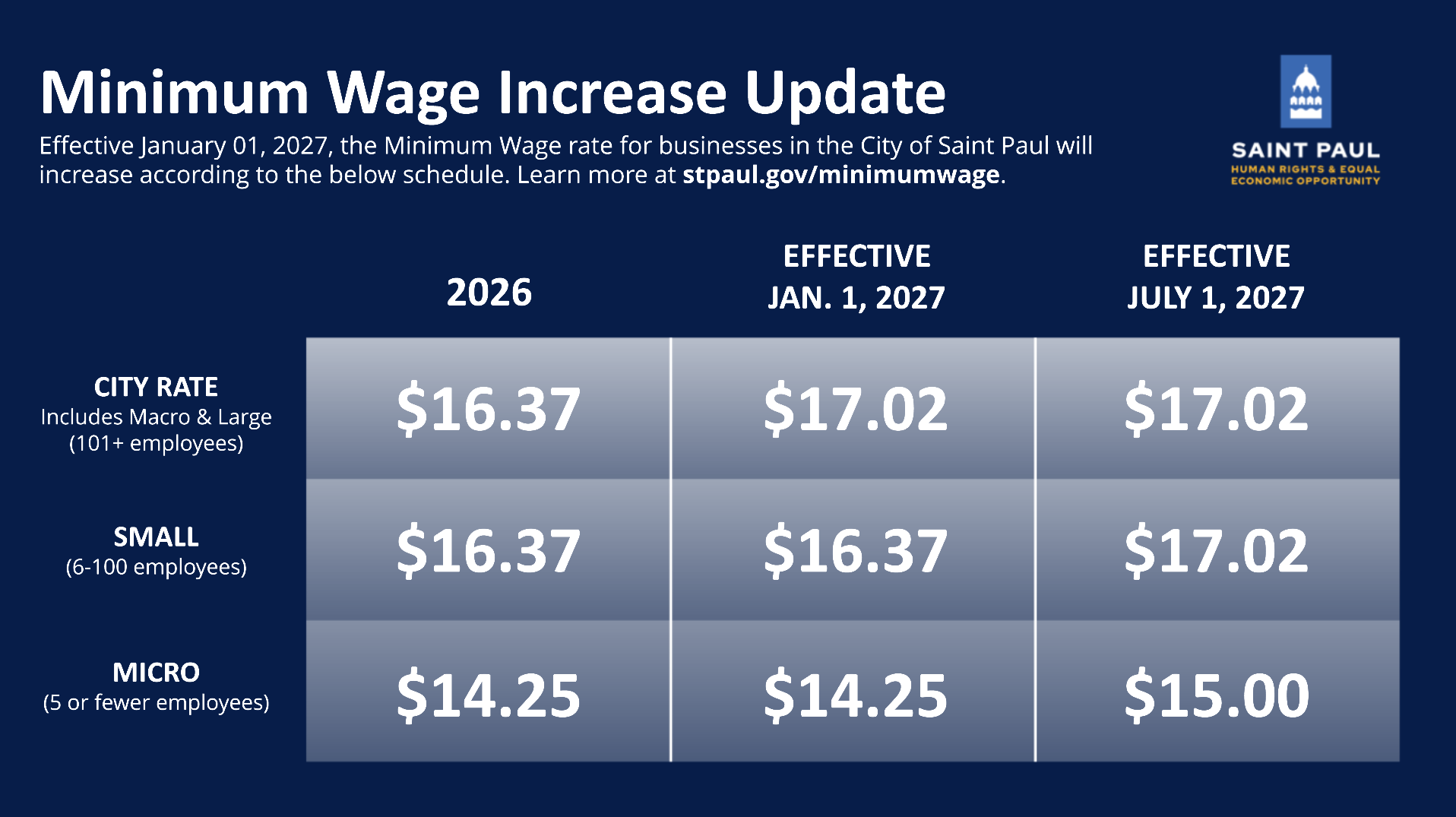
| Minnesota | St. Paul | $16.37, 6 or more employees; $14.25, 5 or fewer | 101 or more: $17.02 on January 1, 2027. 6-100: $17.02 on July 1, 2027. 5 or fewer: $15.00 on July 1, 2027 |
| New Mexico | Albuquerque | $12.00 | $13.00 on January 1, 2027; $12.00 with qualifying benefits |
| New Mexico | Santa Fe | $15.40 | $17.50 on January 1, 2027 |
| New Mexico | Santa Fe County, unincorporated | $15.40, covered businesses | March 1, 2027; not yet posted |
| Washington | Bellingham | $19.13 | 2027 rate not confirmed |
| Washington | Burien | $21.78, 501 or more employees; $20.78, 16-500; $19.28, 15 or fewer | In 2027: $22.49, 16 or more; $20.49, 15 or fewer |
| Washington | Everett | $20.77, over 500 employees; $19.77, 15-499; 14 or fewer not covered | 2027 rate not confirmed |
| Washington | King County, unincorporated | $20.82, over 500 employees; $19.82, most others; $18.32, 15 or fewer with under $2M revenue | $21.57 on January 1, 2027; $19.57 for 15 or fewer with under $2 million in revenue |
| Washington | Renton | $21.57, 15 or more employees; 14 or fewer not covered | $22.28 on January 1, 2027, large and mid-size employers |
| Washington | SeaTac | $20.74, hospitality and transportation employers | 2027 rate not confirmed |
| Washington | Seattle | $21.30 | $22.14 in 2027 |
| Washington | Tukwila | $21.65, 15 or more employees worldwide or other tests | 2027 rate not confirmed |
Some county rates cover only unincorporated areas. Tiers by employer size follow each city’s own rules, so read its page before you rely on a tier.
Tipped workers
The federal cash wage is $2.13 an hour, and tips must make up the rest of the $7.25. Many states set a higher cash wage. Alaska, California, Minnesota, Montana, Nevada, Oregon and Washington allow no tip credit, so tipped workers get the full rate. If tips fall short, the employer pays the difference.
Sources
Sources: 200 official pages
- 29 U.S.C. 206(a)(1)(C)
- 29 U.S.C. 206(a)(1)(C) (OLRC release point Pub. L. 119-136, Oct. 22, 2026, usc29.xml)
- U.S. DOL WHD, Minimum Wage page
- 29 U.S.C. 203(m)(2)(A)(i)
- 29 CFR 531.50(a)
- U.S. DOL WHD, Fact Sheet #15 (tipped employees)
- AS 23.10.065(a)(2)-(3)
- Alaska DOLWD Wage and Hour home page notice
- U.S. DOL WHD, State Minimum Wage Laws (updated July 1, 2026), Alabama entry
- U.S. DOL WHD, Minimum Wages for Tipped Employees, footnote 11
- Ark. Code 11-4-210(a) as amended by 2018 Initiated Act (Issue 5)
- Arkansas Division of Labor, Minimum Wage and Overtime page
- 11 CAR 11-601(a)(1)(A) (Division of Labor Minimum Wage Rules, quoting Ark. Code 11-4-203(3)(B))
- U.S. DOL WHD, State Minimum Wage Laws (Updated July 1, 2026), Arizona entry
- U.S. DOL WHD, Minimum Wages for Tipped Employees, Arizona row
- A.R.S. 23-363(B)
- A.R.S. 23-362(B)-(C) (2006 Prop. 202 version)
- Industrial Commission of Arizona, 2027 Fair Wages and Healthy Families Act notice
- DLSE Minimum Wage FAQ, Q1
- DIR News Release 2026-66 (Aug. 13, 2026)
- DLSE Fast Food Minimum Wage FAQ (AB 1228)
- DLSE Health Care Worker Minimum Wage FAQ, rate table (Lab. Code 1182.14-1182.16)
- CDLE INFO #1 (2026 COMPS & PAY CALC Orders), Rule 3
- CDLE, Statement of Basis for proposed 2027 PAY CALC Order, 7 CCR 1103-14 (dated Oct. 27, 2026)
- CDLE INFO #19, n.5
- CDLE, proposed 2027 PAY CALC Order, 7 CCR 1103-14, Rule 1.2.1 (Sept. 30, 2026)
- CDLE Labor Rules page, Proposed and Recently Adopted Rules table
- C.G.S. 31-58(i)(1)
- Governor’s press release, Aug. 5, 2026
- OLR Report 2026-R-0081, 2026 Acts Affecting Business and Jobs (June 24, 2026), on P.A. 26-12 secs. 6 and 40
- DOES public notice, 2026 minimum wage increase
- D.C. Code 32-1003(a)(6)(A)
- D.C. Code 32-1004(a)
- CFO Fiscal Impact Statement, Proposed Initiative Measure No. 87 (Mar. 26, 2026)
- 19 Del. C. 902(a)
- Fla. Const. art. X, s. 24(c)
- FloridaCommerce, 2026 minimum wage announcement
- F.S. 448.110(4)(b)
- Georgia DOL, Minimum Wage page
- Georgia DOL Employer Handbook (DOL-224, R-11-24), p. 14
- U.S. DOL WHD, State Minimum Wage Laws (Georgia entry)
- DLIR Wage Standards Division, Minimum Wage page
- DLIR Tip Credit Notice HWHL-1a (Rev. 06/22), citing HRS 387-2
- HRS 387-2(a)(10)-(11)
- HRS 387-1 (“Employee”)
- Iowa Code 91D.1(1)(a)-(b)
- Iowa DIAL, Wage Claims FAQ
- Idaho Code 44-1502(1)
- Idaho Department of Labor, FAQ on labor laws
- Idaho Code 44-1504
- 820 ILCS 105/4(a)(1)
- Illinois Department of Labor, Minimum Wage Law page
- IC 22-2-2-4(c)
- Indiana Department of Labor FAQ: Is my employer required to pay minimum wage or overtime?
- K.S.A. 44-1203(a)(2)
- K.S.A. 44-1202(e)(6)
- KRS 337.275(1)
- Kentucky Education and Labor Cabinet, Wages and Hours FAQ
- KRS 337.010(2)(a)6.
- 2026 Ky. Acts ch. 72 (HB 185), sec. 7, amending KRS 337.065(4)
- La. R.S. 23:642(B)
- U.S. DOL WHD, State Minimum Wage Laws (Louisiana entry)
- Louisiana Works (LWC), Labor Law Information Resources
- M.G.L. c. 151, s. 1
- M.G.L. c. 151, s. 7
- Massachusetts Trial Court Law Libraries, Massachusetts law about minimum wage (mass.gov)
- Secretary of the Commonwealth, 2026 Ballot Questions (statewide Questions 1-9)
- Md. Code, Lab. & Empl. 3-413(c)(1)
- Md. Code, Lab. & Empl. 3-419(c)
- Maryland DOL, Minimum Wage and Overtime Law
- Maine DOL, New Minimum Wage Increases (rate table)
- 26 M.R.S. 664(1)
- MCL 408.934(1)
- MCL 408.934d(2)
- Michigan LEO, Minimum Wage
- MCL 408.932(d)
- U.S. DOL WHD, Minimum Wages for Tipped Employees (Michigan row)
- Minnesota DLI, Minimum wage in Minnesota
- Minn. Stat. 177.24, subd. 1(c)
- RSMo 290.502.3 (eff. 2025-08-28, as amended by H.B. 567)
- RSMo 290.512.1
- Missouri DOLIR, Division of Labor Standards, Minimum Wage page
- U.S. DOL WHD, State Minimum Wage Laws (updated July 1, 2026), Mississippi entry
- U.S. DOL WHD, Minimum Wages for Tipped Employees (July 1, 2026), Mississippi row
- Mississippi Legislature, 2026 Regular Session, code-section index for § 17-1-51 (all bills: Died In Committee)
- Montana DLI, 2027 Minimum Wage Determination Letter (Oct. 7, 2026)
- Montana DLI, Montana’s Minimum Wage page
- MCA 39-3-409(2)(b)
- N.C. Gen. Stat. 95-25.3(a)
- N.C. Gen. Stat. 95-25.14(a)(1)
- N.D.C.C. 34-06-22(1)(c)
- ND Department of Labor and Human Rights, Wage and Hour FAQ (N.D. Admin. Code 46-02-07-03)
- N.D. Admin. Code 46-02-07-03(1)
- Neb. Rev. Stat. 48-1203(2) (Laws 2026, LB258; eff. July 18, 2026)
- Nebraska DOL, State of Nebraska Minimum Wage poster (linked from dol.nebraska.gov/LaborStandards/Compliance/RequiredPosters); table row ‘January 1, 2027 | $15.26 | $13.50’
- Neb. Rev. Stat. 48-1202(2)
- RSA 279:21 (tipped base rate)
- U.S. DOL WHD, State Minimum Wage Laws (updated July 1, 2026), New Hampshire
- U.S. DOL WHD, Minimum Wages for Tipped Employees, New Hampshire row
- NJDOL press release, Sept. 29, 2026
- NJDOL Wage and Hour home page
- Laws 2019, ch. 114 (SB 437, enrolled), amending NMSA 50-4-22(A)
- Laws 2021, ch. 10 (SB 35, final), NMSA 50-4-22(A)(5)
- SB 35 (2021) bill page, nmlegis.gov
- Nev. Const. art. 15, sec. 16(1)
- Nevada Labor Commissioner, 2025 Minimum Wage Annual Bulletin (posted June 23, 2025)
- Nevada Labor Commissioner home page
- NY DOL, Minimum Wage
- Governor of New York, ‘New York State Minimum Wage for 2027’
- Ohio Department of Commerce, 2027 Minimum Wage poster
- Ohio Department of Commerce, 2026 Minimum Wage poster
- Ohio Const. art. II, sec. 34a
- 40 O.S. 197.2
- Oklahoma State Election Board, Official Results, June 16, 2026 (statewide; race 30001)
- BOLI, Oregon Minimum Wage
- ORS 653.025(5)(b) (2025 edition)
- Minimum Wage Act of 1968, sec. 4(a.1), 43 P.S. 333.104(a.1)
- PA Department of Labor & Industry, Overtime and Tipped Worker Rules in PA
- PA Department of Labor & Industry, Pennsylvania’s Minimum Wage Act
- HB 2189 (2025-26), bill history
- R.I. Gen. Laws 28-12-3(p)-(q)
- R.I. Gen. Laws 28-12-5(c)
- SD Department of Labor and Regulation, South Dakota Minimum Wage
- SDCL 60-11-3.2
- SDCL 60-11-3.1
- Tex. Lab. Code § 62.051
- Utah Labor Commission, Wage Claim page (FAQ)
- Utah Code 34-40-103(2)(b)
- Utah Admin. Code R610-1-3(A)
- Va. Code § 40.1-28.10(B)-(C)
- DOLI, Payment of Wage (FAQ)
- 2026 Va. Acts ch. 350 (HB 1), chaptered text, amending § 40.1-28.10(C)
- Vermont DOL, Rights and Wages (Minimum Wage Information)
- 21 V.S.A. § 384(a)(1)
- 21 V.S.A. § 383(3)
- L&I, Minimum Wage
- L&I News Release #26-17 (Sept. 30, 2026)
- RCW 49.46.020(2)(b)
- Wisconsin DWD, Minimum Wage page
- Wisconsin DWD poster ERD-9247-P (R. 06/2020)
- Wisconsin DWD, Historical Résumé of Minimum Wage Regulations
- 2025 Senate Bill 374, enacted text posted by the Office of the Governor
- W. Va. Code § 21-5C-2(a)(5)
- W. Va. Code § 21-5C-4
- W. Va. Code § 21-5C-1(e)
- WV Division of Labor, Minimum Wage FAQ
- WV Legislature bill history, 2026 H.B. 5485
- WV Legislature bill history, 2026 H.B. 5671
- Wyo. Stat. § 27-4-202(a)
- Wyoming DWS Labor Standards, Workers & Job Seekers FAQ
- A.R.S. 23-364(I)
- City of Flagstaff, Minimum Wage page
- City of Flagstaff News Flash, Sept. 11, 2026
- City of Tucson, Tucson Minimum Wage Act page
- A.R.S. 23-362(B) (1997 version, still shown)
- DLSE Minimum Wage FAQ, Q3
- City of Los Angeles, Office of Wage Standards
- San Francisco OLSE, Minimum Wage Ordinance
- Los Angeles County DCBA, Minimum Wage, FY 2026-27 notice
- City of San Diego OLSE, Earned Sick Leave and Minimum Wage page, rate schedule
- City of San Diego, 2027 Minimum Wage Official Notice (Sept. 2026)
- City of Oakland, Workplace and Employment Standards, posters page
- City of Pasadena, Official Notice effective July 1, 2026
- CDLE INFO #19 (citing C.R.S. 8-6-101(3)(a)(I), (7))
- Denver Labor, Denver’s Minimum Wage
- C.R.S. 8-6-101(3)(a)(I) (CRS 2024, official printout)
- City of Boulder, Local Minimum Wage page
- Boulder County, Local Minimum Wage page
- City of Chicago, Minimum Wage Information
- Cook County, Minimum Wage Ordinance and Regulations
- Cook County Minimum Wage Ordinance FAQ (07/01/2026)
- Montgomery County Office of Human Rights, Minimum Wage Increase
- Maryland DOL, County Minimum Wage Laws
- Howard County Office of Finance, Minimum Wage (rate chart)
- Maine DOL, New Minimum Wage Increases
- Rockland City Code ch. 2, sec. 2-116(2)
- City of Minneapolis, Minimum Wage
- City of Saint Paul, Minimum Wage (rate tables)
- City of Saint Paul, Minimum Wage Increase Update chart (image on the city page; alt text quoted)
- Minnesota DLI, Minimum wage in Minnesota (local ordinances)
- Neb. Att’y Gen. Op. No. 26-003 (May 7, 2026)
- Neb. Att’y Gen. news release, July 17, 2026 (party statement on the Lincoln injunction; official AG site, not a court order)
- Neb. Att’y Gen. news release, Aug. 18, 2026 (suit against Omaha)
- City of Albuquerque, Minimum Wage Information
- City of Santa Fe, Living Wage in the City of Santa Fe
- Santa Fe County, Living Wage Ordinance page
- Santa Fe County news release, Feb. 12, 2026
- L&I, Local Minimum Wage Rates
- L&I News Release #26-17
- Seattle Office of Labor Standards, Minimum Wage
- King County Local Services, Minimum wage in unincorporated King County
- City of Renton, Labor Standards
- City of Burien, Minimum Wage (BMC ch. 5.16)
- F.S. 218.077(2)(a)
- Idaho Code 44-1502(4)
- IC 22-2-2-10.5(b)
- RSMo 290.528.2 (A.L. 2017 H.B. 1194 & 1193)
- N.C. Gen. Stat. 95-25.1(d)
- N.D.C.C. 34-06-23(2)
- Tex. Lab. Code § 62.0515(a)
Every rate was read on an official page and checked a second time. Checked November 4, 2026. How we check facts.
Keep reading
Related guides and tools
Hiring your first employee
Every step in order: I-9, W-4, new-hire report, payroll taxes, posters.
Read the guide →GuideHow to do payroll
Each payday, each quarter, each year: withholding, deposits, Form 941, W-2s.
Read the guide →ToolEmployer setup by state
The payroll accounts to open in each state where work is done.
Open the checker →LookupWorkers’ comp by state
When coverage is required, and how each state treats you as the owner.
Open the lookup →